


What Makes a Landing Page Convert: A PMM Teardown (2026)
Most landing pages describe a product. The ones that convert describe the relief.
The average landing page conversion rate sits at 10.76%, but most pages never get close to that number. Not because of bad design or slow load times. Because of bad framing.
After scaling Web-to-Figma to 50,000 users and building Web-to-MCP to a 20% free-to-paid conversion rate, I have spent hours on landing pages that looked polished and converted terribly. The problem was always the same. The page was written from the inside out.
This blog breaks down the five elements that separate a page that collects visitors from one that turns them into users. No agency required. No A/B testing tool needed. Just a clearer way to think about what your page is actually doing.
The Core Problem with Most Landing Pages
Visitors arrive carrying one question: is this for me?
They answer it in about 8 seconds. If the page does not answer it in that window, they leave. Not because they disliked the product. Because the page made them work too hard to find out.
Most pages fail because they lead with capability instead of relevance. "AI-powered productivity for teams" tells a visitor what the product is. It tells them nothing about whether it solves their problem.
When writing a headline, the target customer is the first thing to consider. What do they know? What is their pain point? The message needs to speak directly to their experience. Most pages skip this entirely and write for themselves instead.
Run this test before rewriting a single word. Open your landing page on a fresh browser. Set a timer for 8 seconds. Ask: does a complete stranger understand what this does, who it is for, and why they should stay, before the timer runs out?
If the answer is no, something in the next five elements is broken.
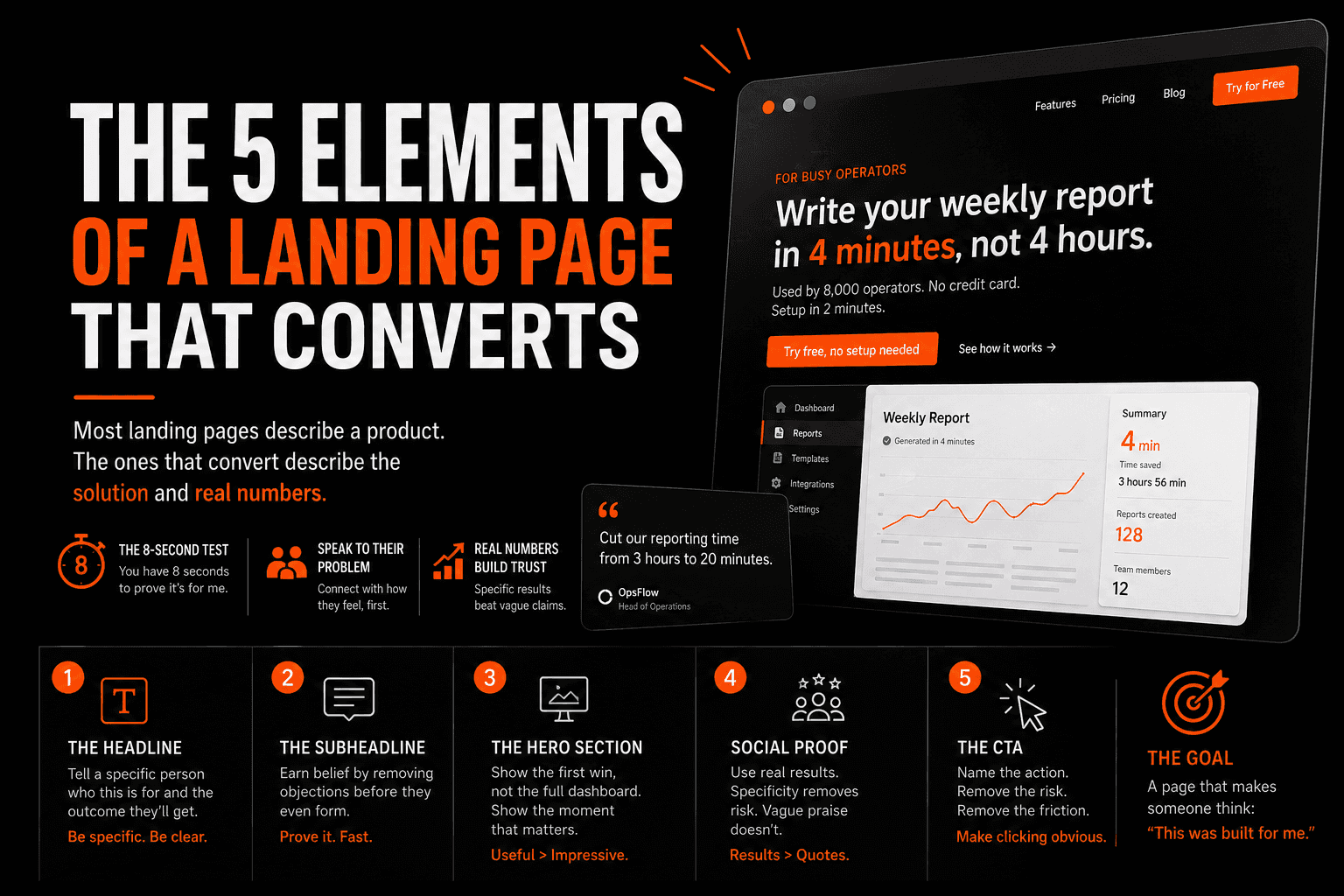
The 5 Elements That Make a Landing Page Convert
1. The Headline
Your headline has one job: tell a specific person that this page is for them.
Weak: "AI-powered productivity for teams."
That sentence could describe 800 products. It signals nothing about the user, the problem, or the outcome.
Strong: "Write your weekly report in 4 minutes, not 4 hours."
Specific person. Specific pain. Specific time saved. A busy ops manager reads that and immediately knows whether to keep going.
The test for a strong headline: remove your logo. Could a competitor copy this word for word? If yes, it is not a headline. It is a category description. Rewrite it until only you could own it.
Using numbers in headlines can increase click-through rate by 36%, and adding a bracket or parenthesis like "(2026 update)" can boost it by up to 38%. Use that when the context is genuinely time-relevant, not as decoration.
2. The Subheadline
The headline earns attention. The subheadline earns belief.
Once a visitor is interested, the next question is: can I trust this? The subheadline should kill the first objection before the visitor even forms it.
Bad: "The all-in-one tool for modern teams."
Better: "Used by 8,000 operators. No credit card. Setup in 2 minutes."
Three things in one line. A proof number, a financial risk removal, and a time barrier removal. Each one is doing specific work. Nothing in that sentence is decorative.
3. The Hero Section
The hero section is the visual contract you make with the visitor.
Most teams show the full product dashboard. Charts everywhere, navigation options, feature menus. That is showing the product to yourself, not to a new user.
Show the most useful moment. Not the most impressive one.
For Web-to-Figma, the hero showed a Figma file populating automatically from a live website. Not a settings screen. Not a feature modal. The exact moment users signed up to experience. That alignment between promise and proof is what makes a hero section work.
Ask yourself: what is the first real win a new user gets? Show that moment. Nothing else.
4. Social Proof
Social proof has one job: remove the fear of being wrong.
"This tool is a game changer!!!" tells the visitor nothing about whether it will work for them.
"Cut our reporting time from 3 hours to 20 minutes" tells them everything.
Specificity is the credibility. Vague praise signals that nobody had anything concrete to say.
If you are early and do not have strong testimonials yet, use your own numbers honestly. "Built by a team that grew a product to 50,000 users in 6 months without paid ads" is proof. It is earned context, not borrowed credibility.
One important 2026 note: Google's E-E-A-T framework now rewards first-hand expertise and original content, making depth and demonstrated authority essential. Social proof is not just a conversion lever. It is an indexability signal. Pages with specific, real, attributed proof points perform better in search than pages with generic claims.
5. The CTA
"Get started" is a placeholder. It tells the visitor nothing about what happens next or what they get.
"Try free, no setup needed" is a CTA. It names the action, removes the financial risk, and removes the time barrier in five words.
Personalized CTAs increase engagement and help guide users toward conversion. The more the button text reflects the specific outcome the visitor came for, the more likely they are to click it. SEO Sherpa
One rule that does not bend: one CTA per fold. Multiple options at the same decision point create hesitation. Hesitation creates exits.
The CTA test: cover everything on the page except the button. Does that text alone make someone want to click? If not, rewrite it until it does.
What 2026 Changes About Landing Page SEO
Three things have shifted this year that directly affect whether your landing page ranks and converts.
AI Overviews now pull from structured, clear content. Zero-click searches now exceed 60% of all searches, and AI-driven results dominate over 25% of queries. This means your page needs to answer questions clearly and directly, not just target keywords. Structure your content so the answer to a common question appears in a clean, extractable paragraph. That is how you get cited by AI summaries.
FAQ schema is no longer the move. As of 2026, Google has largely stopped supporting rich results for FAQ schema markup. Stop adding FAQ schema and focus instead on writing clear, authoritative answers inside properly structured sections. The content quality matters more than the markup. SEO Werkz
Page speed is now a hard conversion variable, not just a ranking signal. Pages that load in approximately 2.4 seconds convert roughly twice as well as slower pages. 53% of mobile users abandon sites that take more than 3 seconds to load. If your hero image is uncompressed or your font is loading from a slow server, fix that before rewriting a single headline. SEO Sherpa
The 30-Minute Landing Page Audit
You do not need a consultant to fix your landing page. You need 30 minutes and honest eyes.
Open your page on a fresh browser, not logged in. Rate each of the five elements from 1 to 5. Find the lowest score. Rewrite only that one element first.
Then run a five-person test. Ask each person, without any context from you: what does this product do and who is it for?
Their answers will tell you more about your framing than any heatmap or session recording.
The Three Non-Negotiables
Every converting landing page does these three things without exception.
Specificity over generality. Every vague word is a visitor you are losing. "Teams" is not a person. "Busy operations managers who prep weekly reports manually" is a person.
One clear next step per fold. No competing buttons. No secondary CTAs pulling attention away from the primary action. Every additional option at the same decision point reduces the chance any option gets clicked.
Friction removal at the CTA. Name the action. State what it costs (or costs nothing). Make clicking feel like the obvious next move, not a commitment.
The goal is not a beautiful page.
The goal is a page that makes someone think: this was built for me.
Quick Reference: Landing Page Conversion Checklist
Before publishing, run through this list:
Headline names a specific person with a specific outcome. Subheadline removes the first objection. Hero shows day-one value, not the most complex feature. Social proof includes a specific number or result, not a generic quote. CTA names the action and removes financial or time risk. One CTA per fold. Page loads in under 2.4 seconds. Mobile layout tested on an actual phone, not just a resized browser. Primary keyword appears in title, H1, first 100 words, and one subheading. Internal links to at least two related posts on the same domain.
If this helped, share it with a founder or PMM who is about to rewrite their homepage. One good landing page can change a product's trajectory.
@2026, All Rights Reserved