


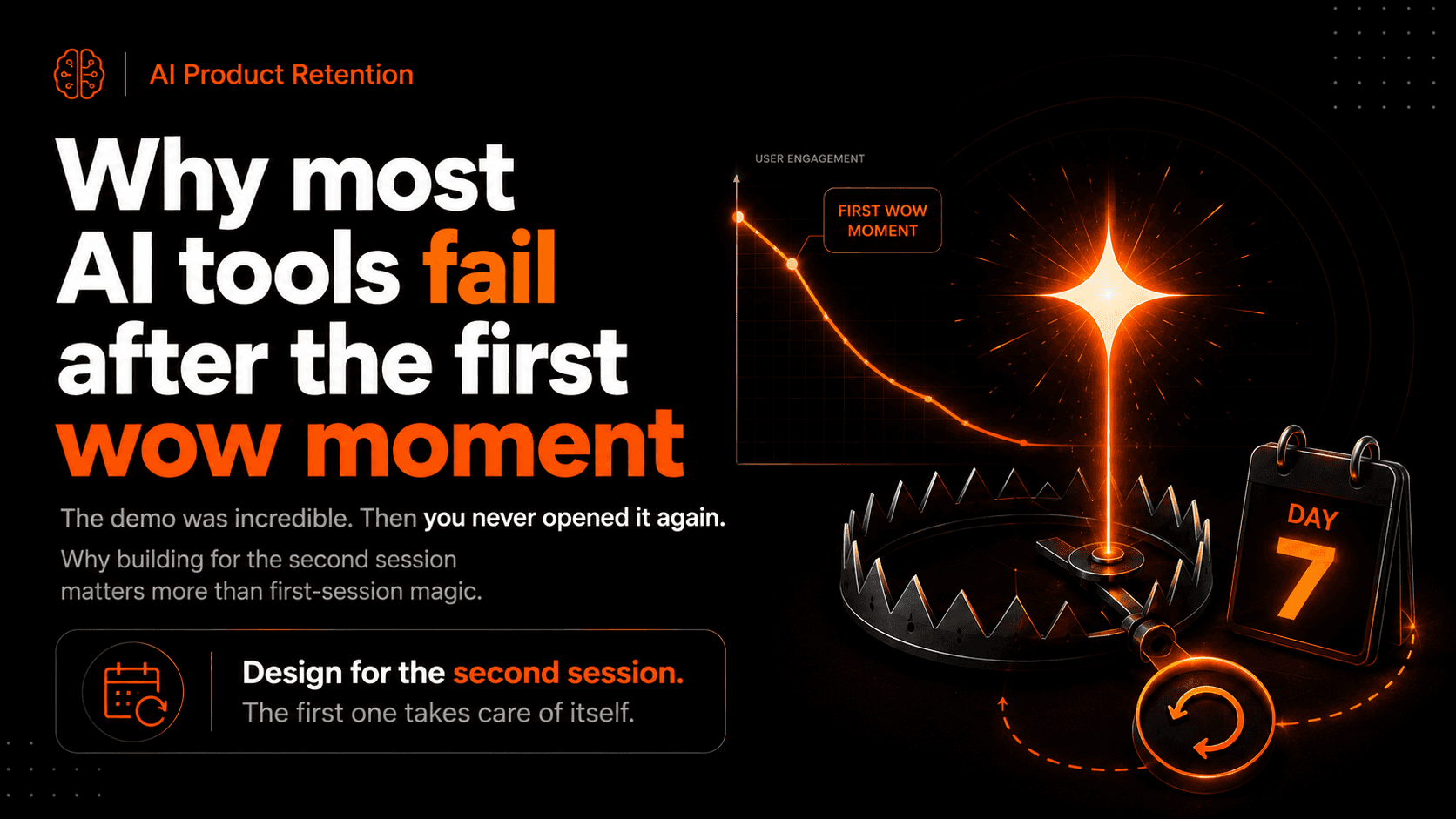
Why AI tools fail after the first wow moment (and how to fix it)
tThe demo was incredible. You typed a prompt, the output appeared in seconds, and you felt something shift. This changes everything. You told someone about it. Maybe you tweeted about it.
Then you never opened it again.
This isn't a you problem. It's a product design problem, one that's quietly killing the retention curves of hundreds of AI tools that mistake a wow moment for a growth strategy.
The dopamine trap in AI onboarding
AI products are unusually good at creating first-session magic. The output quality, the speed, the sense of capability, it all floods in at once. Your brain registers this as a reward. Dopamine fires. You feel like you've gained a superpower.
The problem: dopamine is not habit. It's novelty.
Novelty fades by design. The same output that felt miraculous on day one feels ordinary by day three. This is not a flaw in the user. It's basic neuroscience. And most AI product teams are unknowingly building for the dopamine spike, not for what comes after it.
The best onboarding flows in SaaS history weren't built to impress. They were built to create dependency: a small, repeatable action that becomes part of how you work. Slack didn't wow you. It quietly became the place where things happened.
AI tools are doing the opposite. They're optimising for the screenshot moment, the demo clip, the "look what this thing can do" tweet. And then they're wondering why D30 retention looks like a cliff.
What happens after the novelty wears off?
Here's what the second-session experience looks like for most AI tools:
The user returns with a real problem, not a demo problem. They type a messier prompt. The output is less clean than they remembered. There's no guidance on what to do next. The interface looks the same as it did on day one, offering no signal that it knows this user has been here before.
The user closes the tab.
This is the moment most products lose the game. Not because the product is bad, but because no one designed for it.
When I was working on the growth side of Web-to-Figma, the first-session numbers looked strong. Users were activating, converting pages, seeing results fast. But the real question was always: did they come back on day seven to do it again, without a prompt? That second return, unprompted and uninstructed, is the only honest measure of whether your product has become part of someone's workflow.
3 things that separate sticky tools from one-hit wonders
They define a core action, then build a forcing function around it.
Sticky tools know exactly what users need to do to get value, and they create a reason to do it again. A habit loop isn't built by the AI doing something impressive. It's built by the user accomplishing something they needed to accomplish, then needing to accomplish it again tomorrow.
They personalise the second session, not the first.
Most personalisation work happens at onboarding. Smart products personalise the return. They show you what you did last time. They suggest what to do next. They make re-engagement feel like continuing something, not starting something.
They have a reason to exist on a Tuesday afternoon, not just a Monday morning.
The best retention question to ask about any AI tool isn't "would someone recommend this?" It's "would someone miss it if it disappeared on a random Wednesday?" If the answer is no, you have a product people admire, not a product people use.
A framework for designing the second session, not just the first
Before your next sprint planning, run your product through these four questions:
The Second Session Framework
1. What is the one core action that delivers the real value of this product?
2. Does our onboarding end when that action is complete — or when the user is primed to repeat it?
3. What does a user see when they return on day 3 with no email prompt, no notification?
4. What would make a user open this tool on a random Tuesday afternoon, without being reminded to?
If you can't answer questions 3 and 4 clearly, you've built an impressive first act. You haven't built a product yet.
Conclusion
The tools that survive the next two years won't be the ones with the best demos. They'll be the ones that quietly, unglamorously, became part of how someone works — even after the novelty was long gone.
Design for the second session. The first one takes care of itself.
@2026, All Rights Reserved