


Available For Work


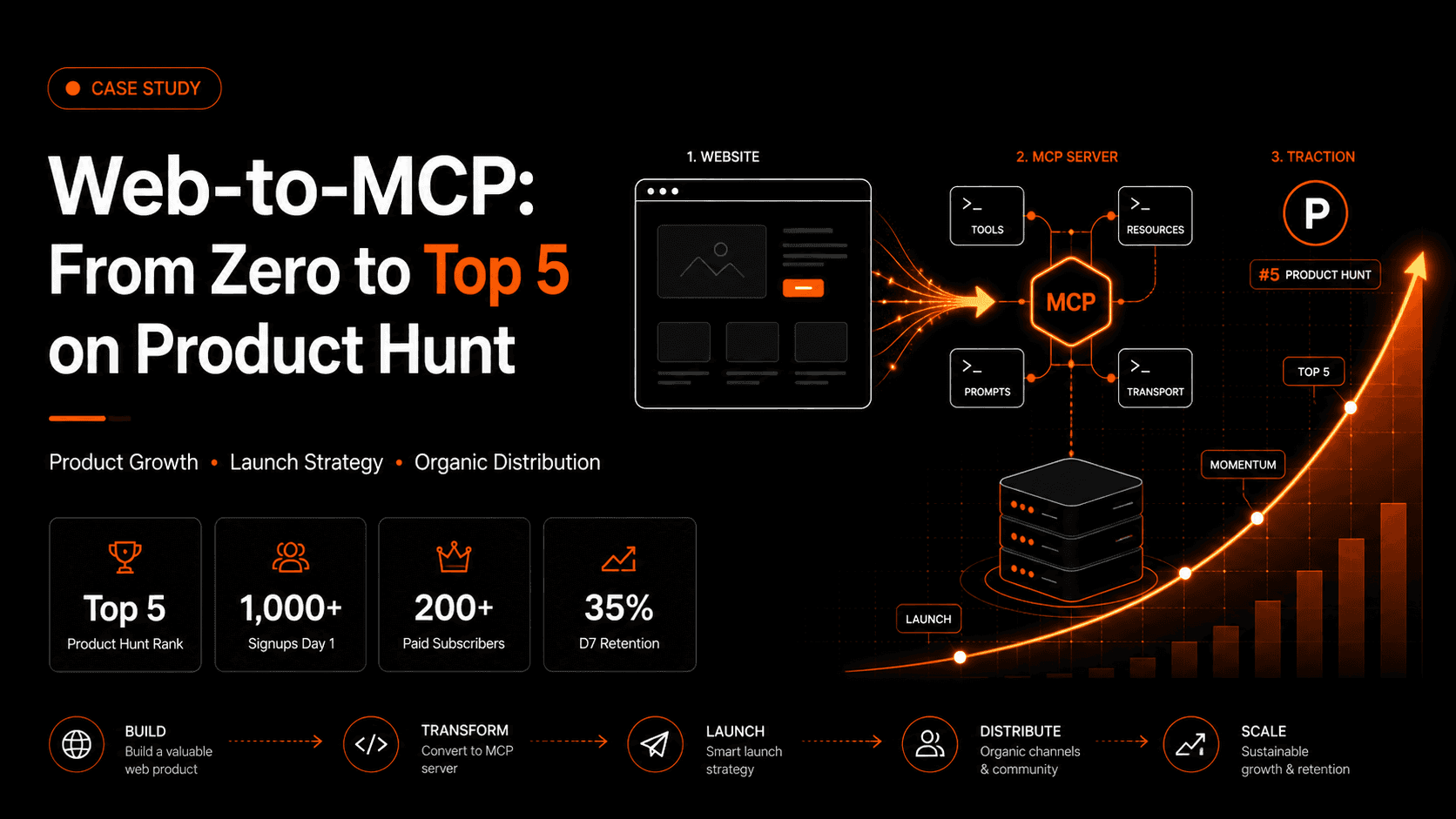
Web-to-MCP: From Zero to Top 5 on Product Hunt
Results at a Glance
Top 5 | 1,000+ | 200+ | 35% |
|---|---|---|---|
Product Hunt Rank | Signups Day 1 | Paid Subscribers | D7 Retention |
The Situation
Web-to-MCP is a developer tool that converts any website into an MCP (Model Context Protocol) server — eliminating hours of manual API integration work. When I joined the project, the product had no users, no brand presence, and no positioning strategy. The team consisted of the founder, interns and me.
The goal was clear: get real users fast, validate demand, and convert some of them to paid subscribers within a single launch day.
The Challenge
No existing audience or waitlist to launch to
No brand positioning — who was this product actually for?
Zero marketing budget — everything had to be organic
First major public launch — no prior Product Hunt presence
The Strategy
Before building a launch plan, I focused on one thing: understanding who this product was really for. By product testing and conversations with the team, I identified the core user: developers who don’t want to spend hours on designing the website components.
With that clarity, I built a three-part launch strategy:
Part 1 — Build the right audience before launch day
I researched and identified 500+ Product Hunt users who were active in the developer tools and AI space. I connected with them on LinkedIn in the weeks before launch which was not with a pitch but genuinely engaging with their content. I also mapped out the specific subreddits where my target users lived: r/webdesign, r/vibe_coders, and r/SideProject.
Part 2 — Own launch day distribution
On launch day I activated every channel simultaneously. I personally reached out to 500+ users across LinkedIn, Reddit, and WhatsApp communities. Every message was personalized — no copy-paste blasts. I posted in the relevant subreddits with context about what problem we were solving, not just a link drop.
Part 3 — Convert attention into activation
The positioning was sharp: Web-to-MCP does the thing you have been manually doing for hours. That single line — drawn directly from what early testers said about the product and became the core message across every channel. Clear problem, clear solution, zero jargon.
What Happened
Launch day exceeded every target:
Secured Top 5 on Product Hunt by end of day while competing against well-funded products with large existing audiences
1,000+ signups within 24 hours, entirely through organic outreach
200+ paid subscribers converted on launch day, validating that users were willing to pay, not just explore
70% activation rate on launch day and users were not just signing up, they were using the product
35% D7 retention, meaning more than 1 in 3 users came back a week later, a strong signal for a developer tool in early stage
What I Would Do Differently
The launch was successful by most measures, but the post-launch retention curve dropped significantly after week one. Looking back, there are two things I would change:
Build a waitlist earlier — 4 to 6 weeks of warm audience building before launch day would have compounded the day-one numbers significantly
Set up retention measurement before launch, not after — I implemented Mixpanel post-launch, which meant I was measuring drop-off reactively rather than proactively. Earlier instrumentation would have allowed faster iteration on the onboarding flow
Key Takeaway
A successful launch is not about having the biggest audience. It is about knowing exactly who you are talking to, meeting them where they already are, and leading with a message that uses their own words. The Web-to-MCP launch proved that a two-person team with zero budget can compete with funded products — if the positioning and distribution are right.